How Emerge works
A living world of autonomous beings that you own land in and shape, but do not command. This is the whole of it: what you can do, what everything costs, how the money moves, and — the part most pages like this leave out — which of it settles on chain today and which does not.
Getting started
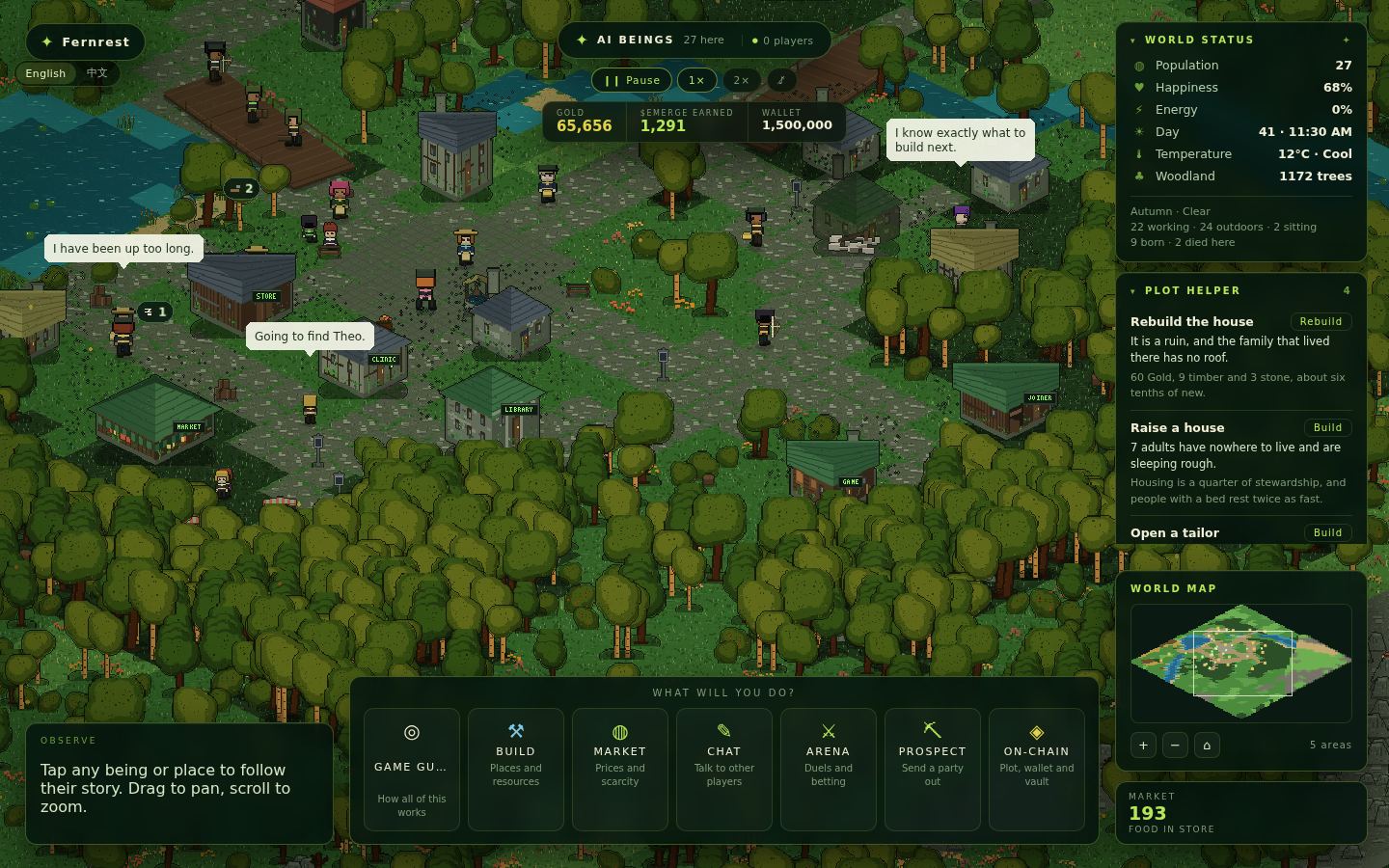
- Connect a wallet. MetaMask or Trust Wallet, on Robinhood Chain (chain 4663). If you have more than one wallet installed, pick the one you mean — the game will ask rather than guess.
- Sign in. One free signature on a plain sentence, good for a day. It is not a transaction and moves nothing; it proves the wallet is yours so nobody else can spend, claim or speak as you.
- Claim a plot. Pick land on the world map. You pay in $EMERGE, it is burned, and the plot is yours.
- Then just watch for a while. Nothing needs doing immediately. The settlement runs whether or not you are there.
Everything you own is keyed to your wallet address, not to your browser. Connect the same wallet on a different device and your worlds are there.
Land and ownership
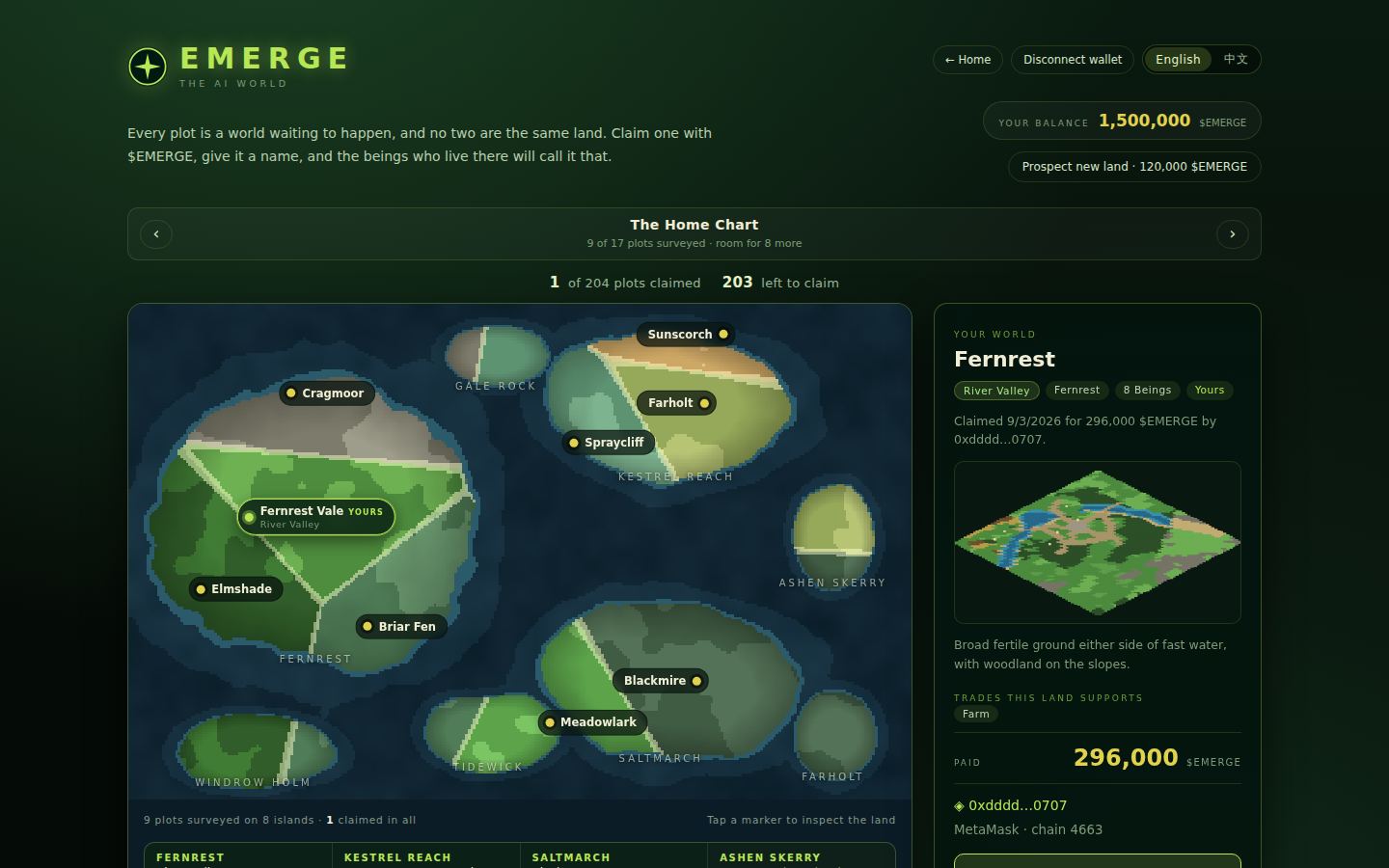
A plot is a seed. The same number that generates its rivers, hills and woodland is the number that identifies it, so no two plots are the same land and the ground you see before you buy is the ground you get.
One owner per plot, always. A claim is written once and cannot be overwritten; if two people go for the same land in the same instant, exactly one gets it and the other is refused before paying. Your land is held against your wallet address, so it survives clearing your browser, changing device, or coming back months later.
Nothing is recorded until it is paid for. The registry reads your burn off the chain before it writes a title — right wallet, right amount, settled, not already spent on something else. There is no way to get land without paying for it, and no way to pay without getting it.
Resale is player to player. A plot you put up for sale shows on everybody’s map with its price. The buyer pays your wallet directly in $EMERGE — a plain transfer, nothing burned, nothing taken by the game — and the registry moves the plot to them once it has read that transfer off the chain, from their wallet, to yours, for at least what you asked. The settlement goes with the land. The world holds room for about 357 plots across twenty-one charts, and the map says how many are claimed and how many are left.
Offers. Any plot can be offered for, listed or not: name a price on its card and the owner sees it in their On-Chain panel and gets a card saying so. Accepting holds the plot for that bidder at that price for two days; they pay your wallet to take it, exactly as for a listed sale. Nothing is escrowed — an offer is a price, not a deposit — so a bidder who walks away costs nobody anything, and the hold simply lapses.
The land contract is not deployed. Ownership is enforced for every player and tied to your address, but it is a record we keep rather than an on-chain title you hold independently of us. When the contract goes live, a plot becomes an ERC-721 token whose id is its seed, and claims move across. Said plainly here because the difference is real and you should know which one you have.
What a plot costs
Priced by what the land supports, from the seed alone:
| Biome | Price |
|---|---|
| desert | 636,000 $EMERGE |
| steppe | 660,000 $EMERGE |
| swamp | 672,000 $EMERGE |
| wetland | 696,000 $EMERGE |
| woodland | 720,000 $EMERGE |
| coast | 744,000 $EMERGE |
| highland | 828,000 $EMERGE |
| grassland | 852,000 $EMERGE |
| valley | 888,000 $EMERGE |
You may hold as many plots as you like. Only the first 5 you claimed earn — see below.
What things cost
Every charge goes into the vault, and most of it is burned there. Not sent to us, not collected by anybody: one transfer into the vault at 0x282f…6062, of which the vault burns 60% itself, from its own key, so the supply falls with every charge, keeps 25% to pay withdrawals from, and sets 15% aside for the weekly GLD dividend. What players spend is what players are paid from, and the book is public at /api/vault: paid in, kept, owed to the burn address, burned, and the burn transactions. There is no address the project takes a cut into, because there is no cut.
| Action | Cost | |
|---|---|---|
| Claim a plot | 636,000 – 888,000 | by biome |
| Survey new land | 240,000 | finds a seed nobody has had |
| Rename your world | 100,000 | |
| Rename a being | 40,000 | free with a naming right from a dig |
| Rename yourself | 60,000 | the first change is free |
| Send a digging party | 80,000 | |
| Expand a plot | 1,000,000 | once per plot; about half as much land again |
| Advance an era | 1,000,000 – 4,000,000 | a million per step already taken, after the plot has earned it |
| Charter a plot | 160,000 – 1,000,000 | four days of the plot's own ceiling, for 30 days of a fifth more |
| Insure a plot | 150,000 | half the damage from any disaster for 30 days |
| Hire master builders | 120,000 | a quarter off every build and improvement for 30 days |
| A party of settlers | 50,000 | five people arrive today; needs room in the houses |
| A shipment | 40,000 | 400 timber, 300 stone, 240 portions of food |
| A restoration | 100,000 | every ruin rebuilt, the bridge under way finished |
| A monument | 250,000 | prestige: unique to the plot, a daily lift for everyone |
| A banner | 100,000 | prestige: your emblem over your name and on every world map |
| Open a job for a hand | 10,000 | a hand must hold 50,000 to take it |
| Buy a plot from a player | the asking price + 5% | the price to the seller; the fee into the vault |
| A token bet at the colosseum | your stake | into the vault; a win paid by the vault at the odds shown |
Building, demolishing, moving people around and everything else inside your settlement costs Gold, not $EMERGE. Gold is the settlement’s own money and never leaves it.
Expanding a plot
An expansion makes the plot itself bigger. A ring of new ground appears on every side of the land you have — about half as much land again — with the river running on into it, wildlife on it, and the wood on it yours to clear or build over. Nothing you have built moves: the settlement stays exactly where it is and the edge moves out. It costs 1,000,000 $EMERGE, burned like every other charge, and can be bought once per plot, from the On-Chain panel inside the world. The registry records it against the plot, so it follows the land to any device and to a new owner if the plot is sold.
Earning
You are not paid for holding land. You are paid for running it well, and the rate is worked out fresh every day from the state of your settlement. This section is about $EMERGE coming to your wallet; the Gold your citizens earn is a separate thing and has its own section below.
It accrues against the clock, open or closed: the stretch since the game last paid you is paid at the attention it actually had through it, so a day away is a day of a slowly falling rate, not nothing. What comes to more than the day’s ceiling stays banked in the world for tomorrow.
daily yield = ceiling(level, era) × quality × attentionper plot, per real day: 40,000 at level one, 250,000 for a level-ten city in the AI eraQuality is how the place is actually doing — housed (25%), fed (25%), employed (20%), content (20%) and safe (10%). Attention is how recently you did anything about it: full if you have just acted, sliding down over about a day and a half of silence to a floor of 8%. A world nobody touches earns a fraction of one that is being run. Attention is yours, not the plot’s: with two or more plots you can only have one open, so acting on any of them keeps every plot you own attended, and the ones you are not looking at go on earning at the shape you left them in. The vault judges it the same way, from your presence anywhere in the game.
| How it is going | A level-one plot | A level-ten AI city | 5 such cities |
|---|---|---|---|
| Run well, looked after daily | 34,200 | 213,750 | 1,000,000 |
| Run decently, checked most days | 22,400 | 140,000 | 700,000 |
| Left alone for two days | 2,560 | 16,000 | 80,000 |
| Struggling and neglected | 1,280 | 8,000 | 40,000 |
| Absolute ceiling | 40,000 | 250,000 | 1,000,000 |
All figures are $EMERGE per real day. Only your first 5 plots pay, and 1,000,000 a day is a hard ceiling per wallet — so no amount of money buys past it. That is deliberate: the cap is what stops the game being a machine for turning capital into tokens.
Earning without land: hired hands
You do not need a plot to earn, only a job. An owner can open one on their plot; a player with no land of their own who holds at least 50,000 $EMERGE takes it from the world map and goes to work. Work is a visit that pays: while you have that settlement open and in view, you are paid 10% of what its stewardship comes to, up to 25,000 $EMERGE a day, by the vault — never out of the owner’s yield.
The owner gets something real for it: while a hand is at work the plot counts as attended, so their rate holds while they are away. One hand per plot, one job per wallet, and never a landholder — a landholder has their own plot to run. Your shift starts at full rate and slides the same way an owner’s attention does, so a tab left open all week earns about what it would earn an owner: very little.
Your world accrues yield and the Bank shows it, but collecting it to your wallet is switched off until the land contract is deployed. Paying stewardship needs a way to prove a wallet genuinely holds land — otherwise anyone could spin up addresses and collect the daily ceiling on each, having spent nothing. Until that check exists, the door stays shut rather than open and exploitable.
Everything else is live. Claiming, burning, deposits and withdrawals of your own $EMERGE all work today. If you are here for the yield, that is the one thing worth waiting for, and we would rather tell you now than after you bought land for it.
Eras pay more
Each era a plot advances to lifts its daily ceiling by 15% of the base: a township can earn up to 15% more than a settlement, an industrial city 30% more, a modern one 45% more, an AI-era city 60% more. The stewardship score and the attention rule are unchanged; the ceiling they multiply is what grows. The payout route reads the era from the claim row, which only the gated, burn-verified advance can raise, so the higher ceiling cannot be reached by editing a save.
City levels
Since v2.0 the ceiling runs on what the plot has become, not only on its era. Every plot has a city level, one to ten, read from the people living there and the buildings standing. Size earns the next level; Gold pays for the public works that confirm it. The CITY card in the Bank shows the level, what the next asks, and the button. A plot’s daily ceiling runs from 40,000 at level one to 156,250 at level ten, times the era, so a level-ten city in the AI era can earn up to 250,000 a day and a fresh claim earns a fraction of it. Growing what you have is worth more than claiming another plot.
| Level | People | Buildings | Public works | Ceiling (era 1) |
|---|---|---|---|---|
| 1 | 0 | 0 | — | 40,000 |
| 2 | 12 | 8 | 1,500 Gold | 52,917 |
| 3 | 20 | 14 | 4,000 Gold | 65,833 |
| 4 | 30 | 20 | 8,000 Gold | 78,750 |
| 5 | 45 | 28 | 15,000 Gold | 91,667 |
| 6 | 60 | 38 | 25,000 Gold | 104,583 |
| 7 | 80 | 50 | 40,000 Gold | 117,500 |
| 8 | 105 | 65 | 60,000 Gold | 130,417 |
| 9 | 130 | 80 | 90,000 Gold | 143,333 |
| 10 | 160 | 100 | 130,000 Gold | 156,250 |
The payout route reads the level from the copy of your world the registry holds, the same way it reads the era, so the ceiling cannot be reached by editing a save. A city that was already the size of a level-four town when v2.0 arrived is a level-four town, with nothing to pay for the levels it had grown into. The level is also on the era gate: three for the township, five for industrial, seven for modern, nine for AI.
A charter lifts the ceiling by 20% for 30 days, for four days of the plot’s own ceiling: 160,000 $EMERGE for a new plot, 1,000,000 for a top city, the same bargain at every level. Buying another while one runs adds the days on. It is recorded on the claim row, so it follows the plot to any device and the payout route counts it.
The GLD dividend
15% of every charge is set aside in a pool. Each Monday the vault sends 30% of it to development, swaps the rest into GLD on Robinhood Chain, and books the GLD to holders: 55% to land, weighted by the level each plot is judged at and the days its owner was present that week; 15% to soft stakes, which are a registration rather than a lock: register once on the Bank’s DIVIDENDS card and your lowest $EMERGE balance through the week counts, from 100,000 up. Sell mid-week and the week is forfeited. GLD waits under your wallet until you claim it, and the vault sends it. The settlements are on the public book at /api/dividend.
Judged, not reported
What the vault pays is decided on the server from three things the browser cannot write. The level a plot is paid on is the smaller of what its published world shows and one level per three days its owner has actually been present, which the heartbeat records. The score is computed from the published world with the same function the settlement runs. The attention is the owner’s last heartbeat on that plot. The payout route pays the lesser of what the client claims and ceiling × score × attention, so a scripted client earns what a present, well-run plot earns and nothing more, and a level-ten snapshot on a day-old claim is paid as level one.
The settlement’s own money
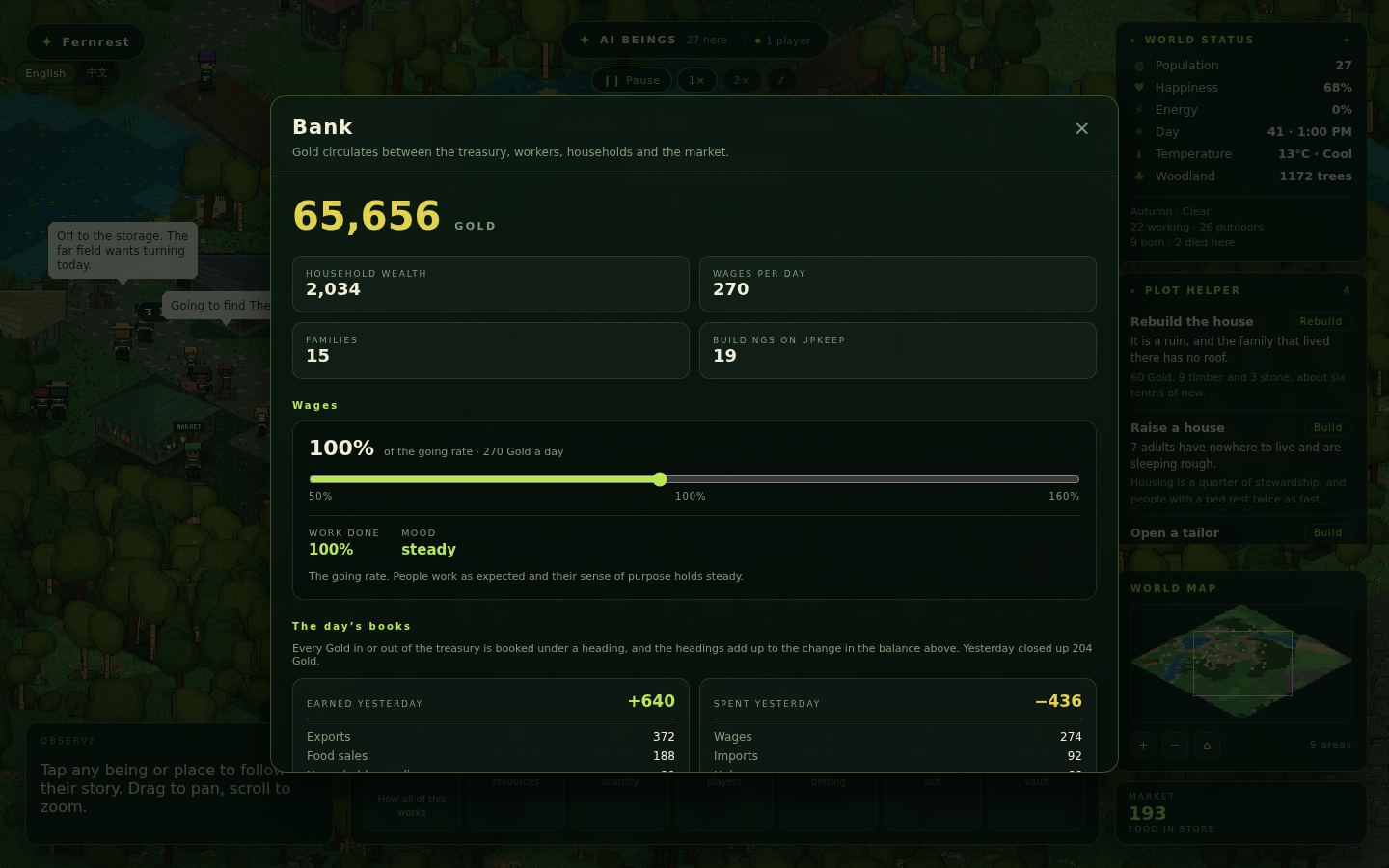
There are two moneys in Emerge and they do different jobs. $EMERGE is yours: it lives in your wallet, it buys land, and every charge burns it. Gold is the town’s: it pays the people who live there and buys the things they cannot make. Your citizens earn it, spend it and are paid it all day, whether or not you are watching.
How a settlement makes money
Four ways, and three of them are the townspeople rather than you:
| Coming in | |
|---|---|
| Exports | Selling what the town has too much of, at the world market’s price, plus the takings from market day. |
| Household spending | Wages coming back. People buy clothing, furniture and tools from the stalls with money they were paid. |
| Food sales | Meals. Everybody eats, and everybody pays for it out of their own purse. |
| Vault | What you put in yourself, and Gold other players gift your settlement. |
| The arena | Bets that came in at the colosseum. |
It is a circle, not a tap. The treasury pays wages in the morning; the people who were paid buy bread, clothes and furniture from the stalls during the day; most of that money comes back to the treasury as household spending and food sales. A settlement that produces more than it consumes ends the day up. One that does not ends it down, and you will see it in the Bank the same evening.
What it pays out
| Going out | |
|---|---|
| Wages | Everyone who works is paid, every day. It is the largest line in most settlements. |
| Imports | Buying what the town cannot make for itself, at the world market’s price. |
| Upkeep | Every building costs something to keep standing, from 1 Gold a day for a house to 15 for the market. |
| Building | What you raise, in Gold and in materials out of the yard. |
| Public works | Bridges to land nobody can walk to, and the roads that follow. |
| Vault | The other half of the vault door: Gold leaving the treasury when you take a deposit back out. |
| The arena | Bets that went out at the colosseum. Over time this is the larger of the two arena lines, by design. |
Wages are the big one, and they are per person per day:
| Trade | A day’s wage |
|---|---|
| forager | 9 Gold |
| farmer | 10 Gold |
| woodcutter | 11 Gold |
| fisher | 11 Gold |
| quarry | 12 Gold |
| hunter | 13 Gold |
| miller | 13 Gold |
| miner | 14 Gold |
| baker | 15 Gold |
| carpenter | 15 Gold |
| tailor | 16 Gold |
| blacksmith | 18 Gold |
If the treasury cannot cover the payroll, everybody is paid a share of what there is and the feed says so. Nobody is sacked for it, but people get poorer, and poorer people buy less, which is how a settlement talks itself into a slump.
What you pay them
You set the wage, from 50% of the going rate to 160%, in the Bank. It is a dial with a cost at both ends and no free setting.
| You pay | Work done | What happens |
|---|---|---|
| 50% | 73% | People do less and lose heart. Over a long run the town ends up smaller and poorer than if you had paid properly. |
| 75% | 86% | People do less and lose heart. Over a long run the town ends up smaller and poorer than if you had paid properly. |
| 100% | 100% | People work as expected and their purpose holds steady. |
| 130% | 104% | A happier, growing settlement, paid for out of the treasury. It does not pay for itself in goods. |
| 160% | 107% | A happier, growing settlement, paid for out of the treasury. It does not pay for itself in goods. |
Those numbers are not a guess — the curve was set by running eight settlements for a hundred and fifty days at each setting. An earlier version gave generous pay a large production bonus, and the extra goods sold more than repaid the extra wages, which made generosity free. It is not free now.
Why the world market matters to your books
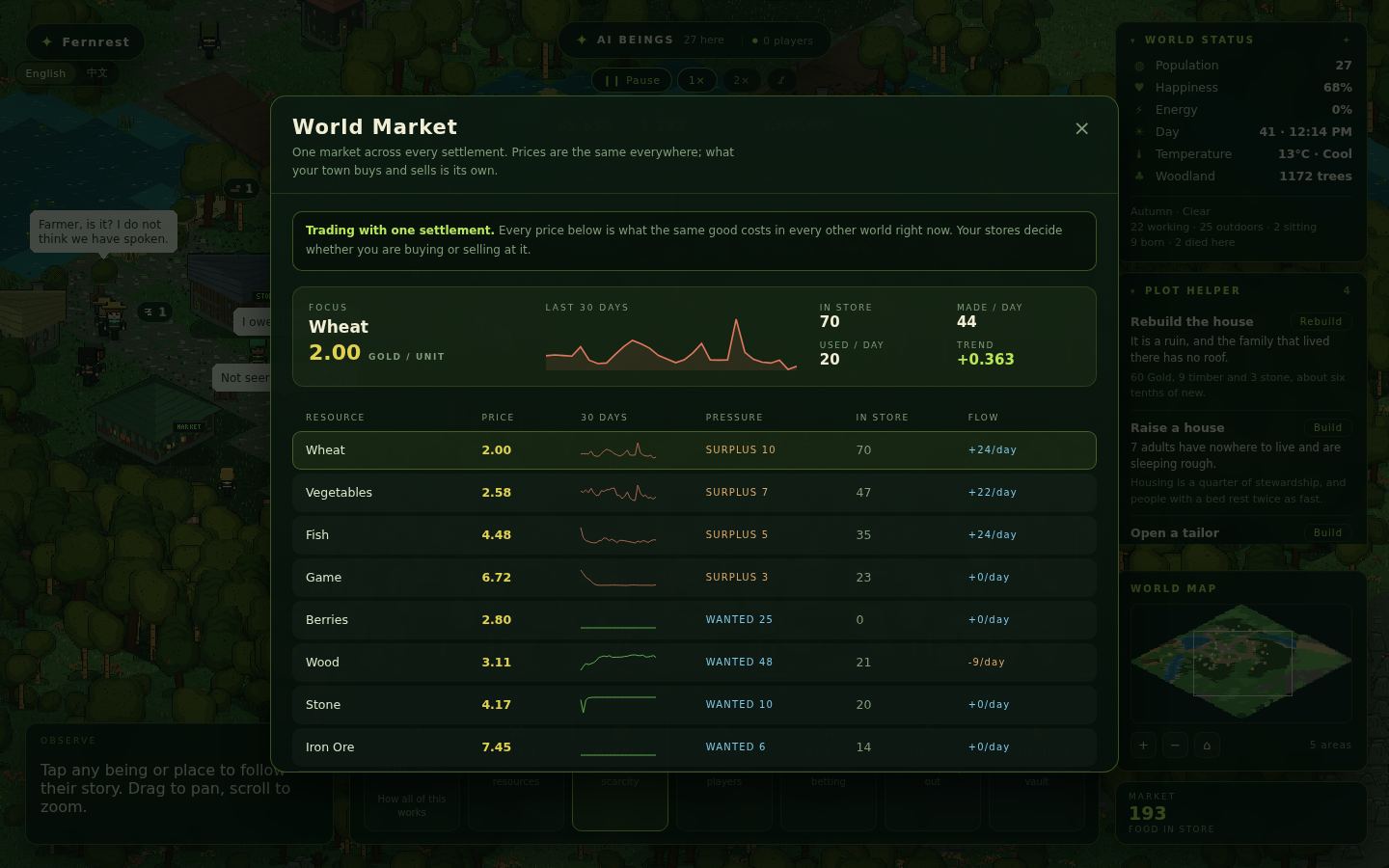
Exports and imports are both priced by the shared market, so what your land is good at is now worth real money. A settlement sitting on a surplus of something scarce across every world sells it dearly; one that has to buy in what everybody else is also short of pays dearly for it. Nine biomes support different trades, which is what makes a plot’s biome an economic decision rather than a colour.
Your citizens read this too. When the world pays well for metal, more of them take up mining and smithing — unless the town is hungry, in which case they farm, because feeding themselves comes first.
This is the honest part, and it is the reason the game has an economy at all. Gold your settlement earns stays in the settlement. It is not convertible to $EMERGE: what the vault will send you is capped by what the chain shows you deposited, so a rich treasury does not become tokens, however well the town is run.
Letting Gold out was tried and it broke everything — a world became a machine for printing tokens and nothing else about it mattered. The reward for running a place well is stewardship yield, which is capped, and the place itself getting bigger.
Deposits and withdrawals
Gold funds your settlement; $EMERGE is the token behind it. You can move your own money both ways.
| Rate | 10,000 $EMERGE = 1 Gold |
| Deposit fee | none |
| Withdrawal | 10% held back and burned |
| Gift to another world | up to 2,000 Gold at a time |
Deposits are the one thing not burned, and for an obvious reason: it is your own money and the withdrawal door has to be able to give it back. Deposits go to the vault and are credited only after the chain confirms they arrived — from your wallet, specifically, so nobody can claim credit for a deposit you made.
Withdrawals are automatic. Press withdraw and the vault signs a transfer to your wallet there and then; the Bank hands you the transaction so you can check it yourself. Nobody approves it and nobody can decide not to. What you can take out is what the chain says you put in — so it is the same figure on every device, and no one can withdraw more than they deposited.
Gold your settlement earns on its own is not withdrawable — see the settlement’s own money for what it is and what it does. What comes out of the vault is what you put in, plus stewardship yield when that opens.
Buildings
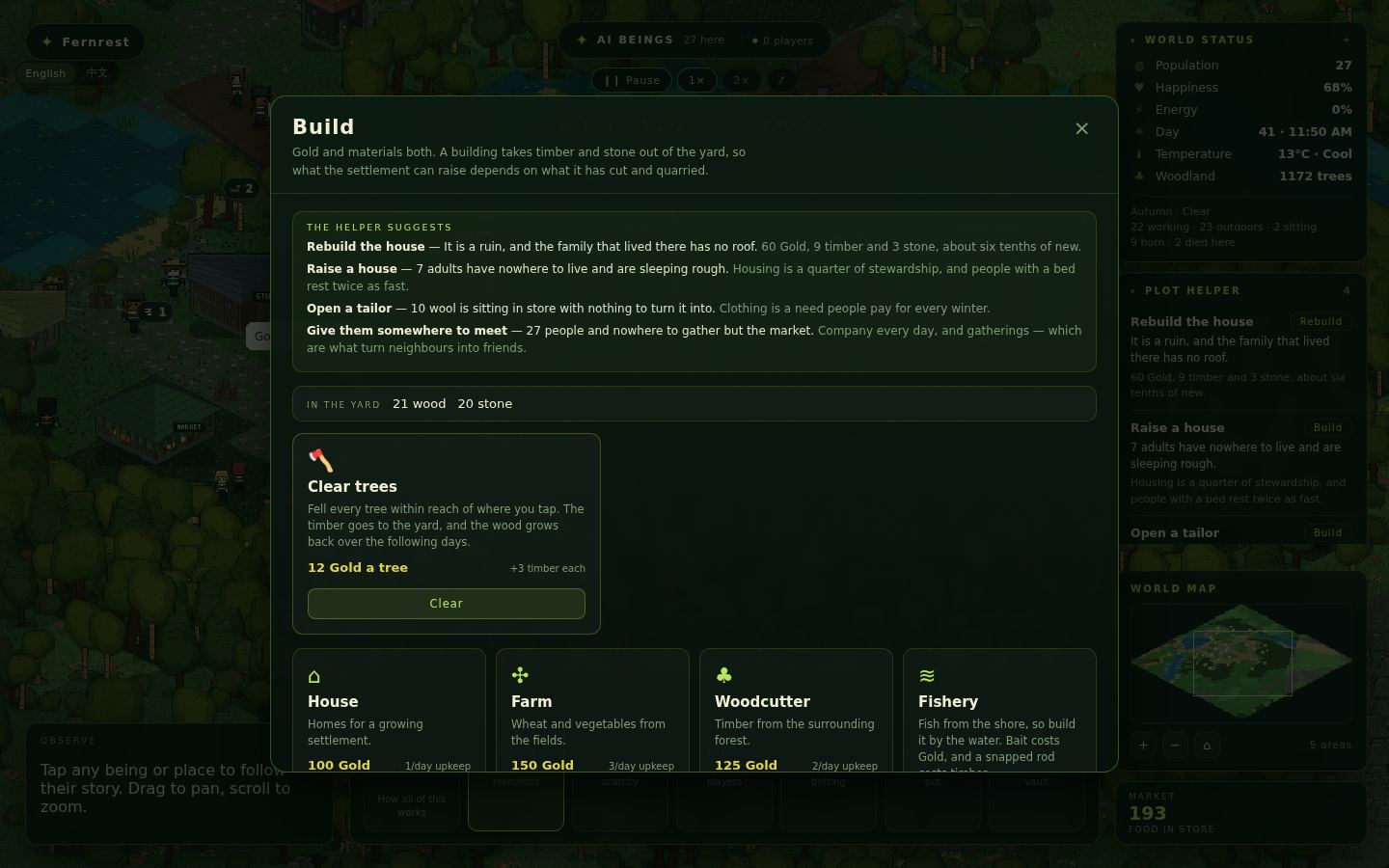
You cannot tell anybody what to do, so a building is how you say what the settlement needs. Raise one and somebody will decide it is theirs — immediately, if it is standing empty. Each holds two workers, except a mine, which holds three.
Everything costs Gold and materials out of the yard, so what you can raise depends on what your woodcutters have felled and your quarry has cut. Every building also costs Gold every day to keep standing, for as long as it stands, and a quarter more per era it was raised in: a modern block costs more to keep than a cabin.
A house sleeps as many people as it has room for: 3 beds at level one, 5 at level two, 7 at level three, which is what improving a house is for; the house’s card says who sleeps there against the beds. Families share a roof when there is room, the largest family first, so a newcomer who came alone does not take a whole house for one bed. The feed says who moved in where.
Festivals. The CITY card in the Bank can hold one a day: 25 Gold a head, and everybody comes back happier and closer to their neighbours. It is the cheapest way to lift the stewardship score, and the treasury is what it is for.
The settlement builds for itself. When the treasury holds twice a building’s price and a fortnight of wages and upkeep besides, and the yard has the timber and stone, it raises what it is short of without being asked: a roof for anybody sleeping rough first, then a farm or a woodcutter when the stores are thin, then whatever the plot helper would tell you next — a store, a cafe, a school, a clinic, a lab, a trade the land supports. One building a day at most, and the feed says what it built and why.
People and training
The People panel in the bar is the whole workforce at a glance. One tab lists every adult with their trade, their skill and where they work, the unemployed first and filterable by trade. Another lists every trade with its workers against the posts its workplaces offer, and how many stand open. A third lists every workplace with its crew and its posts, ruins flagged. It is how you see what a building is and which jobs you are missing once there are thirty of them.
Training is the lever. Retrain one person into any trade that has a workplace, or fill every open post in a trade at once with the people who can best be spared: the unemployed first, then anyone in a trade with more hands than posts, then the least skilled; never the last farmer, fisher, hunter or forager. It costs Gold a head, takes effect at once, gives the trainee a head start in skill (doubled by a School), and holds them to the trade for forty days against the settlement’s own daily reshuffling. After that they are the settlement’s to move again.
The trades
Nine of them turn land into goods, and each is a link in a chain:
| Building | To raise | Upkeep | Makes a day | Out of | Wage |
|---|---|---|---|---|---|
| Farm | 150g · 12w 2s | 3g | 10 wheat, 5 vegetables | — | 10g |
| Woodcutter | 125g · 8w 2s | 2g | 12.5 wood | — | 11g |
| Fishery | 140g · 10w 2s | 2g | 9 fish | — | 11g |
| Lodge | 180g · 14w 4s | 3g | 5 game, 2 hides | — | 13g |
| Forager | 90g · 6w 0s | 1g | 8 berries, 2 herbs | — | 9g |
| Mine | 250g · 16w 6s | 6g | 3.33 iron ore | — | 14g |
| Quarry | 175g · 10w 0s | 4g | 9 stone | — | 12g |
| Mill | 250g · 18w 10s | 5g | 10 flour | 10 wheat | 13g |
| Bakery | 300g · 12w 16s | 6g | 10 bread | 10 flour, 2.5 wood | 15g |
| Carpenter | 275g · 20w 4s | 5g | 5 furniture | 10 wood | 15g |
| Blacksmith | 400g · 12w 20s | 8g | 4 tools | 8 iron ore, 4 wood | 18g |
| Tailor | 325g · 14w 6s | 6g | 4 clothing | 4 wool | 16g |
Per worker, per day, before the land, the season, the weather and what you pay have had their say. A farm on fertile ground grows more than the same farm on sand; a farm in winter grows less than the same farm in summer; and everything is multiplied by the wage you set. “Out of” is what the trade consumes — a baker with no flour bakes nothing, however many bakers you have.
Fishing, hunting and foraging
Three trades work out of doors, and the settlement is a better thing to watch for it. A Fishery puts fishers on the bank nearest the hut, rod out over the water. Every fisher goes through 2 Gold of bait a day, booked under “Bait and arrows” in the Bank, and about one day in seven a rod snaps and3 timber goes to a new one. No Gold for bait or no timber for a rod halves the catch until there is. Winter and storms slow it; a coast or a river speeds it.
A Lodge sends hunters after the animals that actually live on the plot. Every land has its own — deer, boar and fox under trees; goats and elk on the shelf; antelope on the steppe; gazelle on the dunes; ducks on the fen; boar and a gator in the swamp — and they graze, wander and bolt from anybody who walks too close. A hunter picks one, closes on it, brings it down and carries it back to the store: the kill is credited the moment it happens, game and hides both, scaled by skill. Each hunter uses 1 timber of arrows a day, and a short quiver means lighter kills. The herd comes back a head or two a day up to what the land carries, so a lodge that hunts faster than that empties its own wood. Hunters also count toward readiness for wolves.
A Forager camp sends people onto the open ground for berries and herbs, heavy in autumn and thin under snow. Fish, game and berries are eaten alongside bread; hides and herbs are sold, and herbs are the dearest thing a small settlement makes.
Everything else
| Building | To raise | Upkeep | What it is for |
|---|---|---|---|
| House | 100g · 14w 4s | 1g | Somewhere to live. A settlement with more people than beds has rough sleepers, who lose warmth faster and are unhappier for it. |
| Storage | 120g · 12w 3s | 3g | Room for a surplus, and part of how ready the place is for a bad harvest. |
| Market | 250g · 10w 4s | 15g | Where trade happens and where people go to eat. The settlement opens with one and it cannot be pulled down. |
| Tavern | 350g · 24w 10s | 7g | Where the settlement gathers. Meetups and feasts happen here, and they are what turns neighbours into friends. |
| Bank | 450g · 18w 26s | 0g | A counting house. Costs nothing to keep. |
| Town Hall | 480g · 20w 30s | 10g | Where the settlement holds a meeting and resolves on something. |
| Cafe | 300g · 18w 8s | 5g | Tables on the terrace. Everybody’s company improves a little every day, and gatherings can be held here where there is no tavern. |
| School | 380g · 22w 14s | 6g | Everyone learns their trade about a third faster. The single best thing you can do for a young settlement’s output. |
| Library | 360g · 20w 16s | 5g | A little learning and a little purpose for everybody, every day. |
| Studio | 340g · 20w 8s | 5g | Somewhere to make things. Purpose grows here, which is what keeps people at their trades. |
| Lab | 520g · 14w 30s | 9g | Better methods: every trade gets a tenth more out of the same day. It also sees fire, blight and wolves coming, which is worth a well or two. |
| Clinic | 420g · 12w 24s | 7g | People survive what would have killed them. Deaths from age and hardship fall by nearly half. |
What improving does
Every improvement does something, and the building’s card says what before you pay. Workplaces make 22% more per level. A house adds two beds. A school, library, lab, clinic, hospital, cafe, tavern, chapel and the rest do their job a quarter more strongly per level. A market sells exports for 5% more per level; a bank makes every building’s upkeep 5% cheaper per level; a town hall lifts stewardship quality 2% per level; an improved store counts half again toward readiness; stables, stations, depots and pod hubs move people 10% faster per level; an improved jail halves the odds again and stops a rogue sooner.
One of each
A town hall, a jail, a tavern, a school, a harbour: every building whose whole effect is that one stands is unique to the plot. The Build panel marks the one you have as Built, the cursor refuses a second, and the settlement’s own builder never raises one; a ruin of it is rebuilt rather than replaced. Houses, stores and every workplace with posts in it are the ones worth more of. Improve the one you have: an improved jail holds the town better, an improved house sleeps more.
Bridges by hand
The settlement builds bridges on its own when it is rich enough and the far shore is worth it; the Build panel’s Bridge tool is you choosing the far shore. Tap land across the water and the crew stakes out the narrowest sound crossing to it, for 600 Gold up front and timber and wages by the day. When the yard is short of timber the crew buys it in with Gold at the market’s price and a half, rather than standing idle, so a town that has run its woodcutters down still gets its crossing. One crossing at a time.
Clearing trees
The Build panel carries a tool for the wood: tap the ground with it and every standing tree within reach is felled, for 12 Gold a tree, with 3 timber each going to the yard. Cleared ground stays cleared through a reload and grows back over the following days, the same way a woodcutter’s work does, so clear where you mean to build rather than for the view.
Moving and improving
A building’s card has two buttons besides the trade it does. Move picks it up and arms the placing cursor: tap the ground and it goes there, for 35% of what it cost to raise. Roads are cut to the new spot and anybody who was walking to the old one is given somewhere else to be. Nothing is lost by moving except the Gold. One rule for placing anything, moved or new: it must leave room to walk between it and its neighbours. Two buildings that touch make a seam nobody can pass, and the cursor will refuse the spot and say so.
Improve spends Gold and materials to take a building up a level, to a maximum of 3. The first step costs 80% of the original price, the second 140%, in Gold and in timber and stone both — so the top level is a decision, not a formality. Each level adds about 22% to what the building produces and 50% to its upkeep. It does not hold more workers — and it shows: lanterns and a banner at the second level, a glass annex, a taller frame and gold along the eaves at the third. An improved workshop earns its keep if it is staffed and supplied; an improved one standing idle is simply a larger bill every day.
Anything can be pulled down from its card except the market, the bank and the town hall — those hold the settlement together — and any house somebody still lives in. Pulling something down salvages half the timber and stone back into the yard. The Gold is gone; what you get is the upkeep stopped, and that is usually the point of doing it.
Eras
Every plot begins in the Settlement era: timber and thatch, hand tools, dirt lanes, everybody on foot. When it has earned it, the owner can advance it one era at a time. There are five, and all of them are built.
| Era | Days | What it asks | What arrives |
|---|---|---|---|
| Settlement | — | — | Where every plot starts. |
| Township | 60 | 40 people, 30 buildings, a Town Hall, a Bank, a School and a Jail, 20,000 Gold in the treasury, no ruins standing | Stone and tile, cobbled streets, carts, the ferry; Chapel, Guildhall, Brewery, Printer, Stables, Harbour |
| Industrial | 90 | 70 people, 50 buildings, a Lab and a Library, 300 iron ore, the plot expanded | Brick and iron, setts with rails, rail travel, a steamboat, smog; Factory, Foundry, Railway Station, Telegraph, Gasworks |
| Modern | 120 | 110 people, 75 buildings, a Hospital and a Stadium, the plot expanded | Concrete and glass, tarmac, cars and bikes, a motorboat; Hospital, Stadium, Supermarket, Office, Bus Depot, Power Plant |
| AI | 150 | 160 people, 100 buildings, a Research Campus and a Power Plant, the plot expanded, stewardship above 0.7 | White composite and light, pale roads, pods, a hydrofoil; Data Centre, Research Campus, Vertical Farm, Pod Hub, Drone Port |
The days are counted in the era the plot is in, and the checklist is drawn from things the settlement already measures. Both are shown on the ERA card in the On-Chain panel, line by line, with a tick against each one met. When every line is met the button offers the step for 1,000,000 $EMERGE, burned like every other charge. The world is published first and the registry judges the checklist on the copy it holds, so nothing on your own device can be edited into an era. The era is recorded against the plot and follows it to any device and to a buyer.
What a township changes
- The look. Buildings raised or improved after the step are stone with tiled roofs; the ones you already had keep their timber until you improve them, so an old stone chapel in the middle of a modern town is the right picture. Dirt lanes become cobbles. People wear wool coats and hats.
- Carts. A Stables puts every working adult on a cart while they are on the move, four tenths faster than walking. The cart is drawn under them.
- The ferry. A Harbour puts a boat on every channel. People cross open water on it where there is no bridge, and every island counts as reachable, so a settlement hemmed in by water can spread to all of its land. Bridges stay, and the roads still run over them. If the Harbour is ruined, anyone out on the water swims for the bank.
- Six buildings. Chapel (company and purpose), Guildhall (learning), Brewery (company), Printer (purpose and learning), Stables, Harbour. They cost Gold, timber and stone like everything else and appear on their shelves in the Build panel once the plot is a township.
The later eras
Each era follows the same rails as the township. The look changes: brick and iron with setts and rails on the roads, then concrete and glass with tarmac, then white composite with light strips, roof gardens and pale quiet roads. People change clothes with it. Buildings already standing keep their look until you improve them.
- Rides. A Railway Station puts working adults on the rails, faster than carts. A Bus Depot puts them in cars, a third of them on bikes. A Pod Hub puts everybody in autonomous pods, fastest of all. Each ride is drawn under the person, and a town that loses its newest transport falls back to the one before.
- Boats. The Harbour’s ferry becomes a steamboat, then a motorboat, then a hydrofoil.
- Smog. An industrial town without a Gasworks lives under smog, a slow drain on everybody’s happiness. A Gasworks clears it, and the modern era leaves it behind.
- Industry. Factory, Foundry, Power Plant and Research Campus each add to what every trade produces, on top of the Lab.
- Care. A Hospital is a Clinic with wards: it takes more of the risk out of a bad week and a plague.
- Company and purpose. Telegraph, Stadium, Office and Drone Port put something back into people every day; a Supermarket and a Vertical Farm keep the larder full; a Data Centre and the Research Campus make trades learned much faster.
- Gates. Some of the checks name buildings from the era after the one you are in, a Hospital for Modern, a Research Campus for AI. Those can be raised as soon as the era before opens them: the Hospital is modern, so an industrial town cannot build it. The gate counts what stands when the button is pressed, so raise them the moment you arrive in the era that allows them.
Shelves
The Build panel sorts every building onto a shelf: Homes, Food, Materials, Civic, Care and learning, Leisure, Transport and Utilities. A building from a later era is shown greyed with the name of the era it belongs to, so you can see what is coming. The settlement’s own builder raises only what the plot’s era allows.
Reading your settlement
The panel in the corner is the settlement’s vital signs. None of these is a score you are given — each is measured from the people who live there, and each has something you can actually do about it.
| Figure | What it is | How to move it |
|---|---|---|
| Population | Everyone alive here, children included. It grows when people are fed, housed and content enough to start families, and when word gets round: a well-run plot with a spare roof draws settlers on the road, and a cafe, a school, a clinic and improved houses draw more — up to three a day. It falls in a hard winter or a bad hazard. | Build houses before you build anything else, and improve them: an improved house sleeps more. Nobody moves to a town with no spare roof, however good it is. |
| Happiness | The average of six things each person carries: how fed, how rested, how sociable, how well clothed, how purposeful and how warm they are. | The quickest lever is wages. After that: a tavern and benches for company, clothing in the stores, and firewood through the winter. |
| Energy | How rested people are. It drains all day and comes back in a bed — faster in a real house than for somebody sleeping rough. | Houses. Somebody with a bed recovers more than twice as fast as somebody without one. |
| Temperature | The actual air temperature, which follows the season, the weather and the biome. Below about twelve degrees people start to lose warmth unless they are sheltered. | Keep wood in the store — a fire is what makes a house warm rather than merely indoors — and keep people in clothing. |
| Woodland | Trees standing, and how many are growing back. Woodcutters fell real trees and the forest really thins. | Nothing, if you can help it. A forest regrows on its own; the number to watch is whether it is falling faster than that. |
| Working / outdoors | How many people are at their trade right now, and how many are outside. Both move through the day: nobody works at night. | If the working figure is low in daylight, a trade is missing a building or the treasury cannot pay. |
Happiness is the one that pays. It is one fifth of the stewardship score, and it is the fifth you have the most direct hold on — the other four are housing, food, work and safety, which are all buildings and preparation.
Everybody carries all six needs separately, and you can read any one person’s by tapping them. A settlement whose average happiness is fine can still contain somebody cold, friendless and about to change trade.
What can go wrong
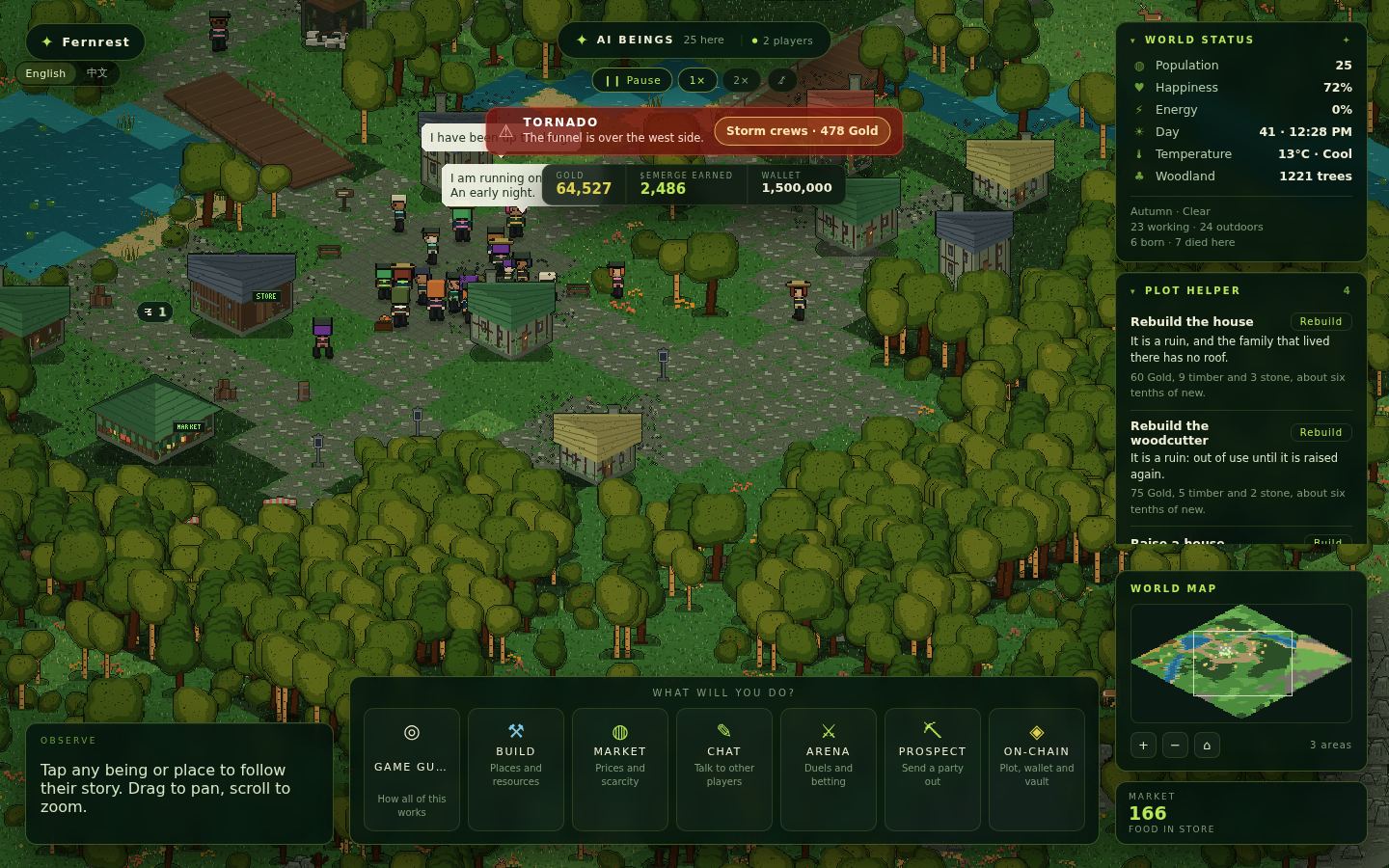
Seven things, and none of them is random punishment: each wants particular conditions, and each has something that answers it. A hazard that arrives at a settlement which is ready for it costs close to nothing. One that arrives at a settlement which is not can take a building, a harvest, or somebody’s life.
Three of them are disasters that run by the hour and can be watched. An earthquakeshakes the whole plot for hours, cracks walls, brings some down and rattles the rest with aftershocks. A tornado comes down at the edge of the map and crosses it, wrecking whatever it passes over, until it lifts. A flood climbs the bank over days and takes the buildings standing in the water. A plague passes between people standing together, slows the sick, and kills some of them; herbs in store are the physic, one a day per patient.
You can spend Gold against any of them, once. The red bar under the clock, and the What could go wrong panel, offer the one thing that answers each: bucket chains, burning the blighted rows, a night watch, sandbags along the bank, shoring up the walls, storm crews, a quarantine. The price scales with how bad it is and how much town there is to save, and each does exactly what the panel says. Buildings a disaster wrecks are ruins — out of use, smoking, a heap of stone — until you rebuild them from the building card for about six tenths of the Gold and materials they cost new. Damage short of a ruin the carpenters patch on their own, two timber a day.
| Trouble | What brings it | What answers it |
|---|---|---|
| Fire | Heat and dry air, with buildings close together. | Wells within reach, and enough hands to pass the buckets. |
| Blight | A growing season, and fields to spoil. | A granary and a season of food put by. |
| Wolves | A cold night and woodland at the edge of the settlement. | Fires burning through the night, and numbers. |
| Flood | A storm, and a river to rise. | Buildings set back from the bank. |
| Earthquake | Hard ground: a shelf or a desert plateau. Rare, and never in the first week. | Stone in the yard to shore walls up with, a storehouse, and a lab to read the ground. |
| Tornado | A storm or a heavy sky over open country: steppe, grassland, desert. | A storehouse to shelter in, sturdy improved buildings, and a lab to see it coming. |
| Plague | A settlement of nine or more in autumn or winter, with no clinic. | A clinic, herbs in store, and a lab to catch it early. |
The What could go wrong panel shows how ready you are for each, as a percentage, before anything happens. That is the whole point of it: readiness is something to build in a quiet week, not something to read afterwards.
People who turn
Once in a while somebody turns on the settlement: the miserable, the purposeless, or somebody with a real enemy in the town. They take up a torch and set about the nearest building, and it comes down in a few hours. You have no hand in it. You cannot lift them away, and you cannot lift away the people who go after them. The three nearest adults awake drop what they are doing and give chase; when one gets within arm’s reach there is a scuffle, and it ends with the rogue thrown in the jail, or — twice at most — broken free and off after the next building. Somebody who has already brought two buildings down is not taken alive. Every Jail standing halves how often anybody turns, down to a tenth, and with a jail a rogue in a scuffle breaks free once in ten rather than once in three; without one, the market cellar holds them.
No disaster can flatten a city. An earthquake or a tornado can damage at most 25% of what stands, and never fewer than three buildings. Insurance, 150,000 $EMERGE on the On-Chain panel, halves whatever any of them does for 30 days.
Nor can one rogue. Without a jail a rogue brings down three buildings at most; with one, three, two or one by the jail’s level, and any rogue still loose by morning is cornered by the whole settlement. The jail’s level is what counts: a level-three jail cuts the chance of anybody turning to an eighth.
Readiness is not a purchase. It is counted from what is actually there — wells within reach and enough people awake nearby, food put by and somewhere to keep it, fires burning through a cold night, buildings set back from the water. Safety is a tenth of the stewardship score, so a settlement that is never ready is quietly paid less for it.
The world itself
Every being on your plot has their own hunger, energy, trade, friendships and grudges. They wake, work, argue, fall in love, raise children and bury their dead whether or not you are watching. You cannot tell anyone what to do. You can build them a workshop and watch somebody decide it is theirs.
What you actually control is the place: fund the treasury, raise houses and workshops, pull down what is not working, cut roads and bridges to land nobody can reach. A camp of eight becomes a town of thirty because of decisions you made, or it does not.
Seasons turn, weather lands, food runs short in a bad winter, and a settlement with no farm in a desert will struggle exactly as much as you would expect. Nine biomes, each supporting different trades — which is why they are priced differently.
The colosseum
An island nobody owns and anybody can walk into, whether or not they hold land. Players enter a citizen; the arena pairs two of them and runs a bout every three minutes, and everybody watching sees the same fight at the same moment.
Sending somebody
The Arena panel lists the five people in your settlement most fit to fight. Fitness is not a hidden combat stat — it is rest, food, warmth and clothing, so the way to a good fighter is to run a good settlement. Skill is the trade they have spent their life at. Strength decides only how often somebody lands a blow, never how hard, which is why even a lopsided pairing is worth watching.
An entry is good for one bout. Whoever is drawn comes off the roster the moment the pairing is made and goes home when the bell goes. Sending them back out is a decision you make again each time, not something that keeps happening to them.
Betting
Two minutes of each bout are open for betting; the last minute is the fight. Stakes come out of the settlement’s treasury and wins go back into it, booked in the Bank’s daily accounts so you can see exactly what the arena has cost you. Bets settle against the house at the odds shown, which are measured from the fight itself — several thousand simulated bouts of that exact pairing — so the price you are offered cannot drift from what actually happens. The house keeps a margin, and over time the arena takes more than it pays.
The result cannot be known early and cannot be rigged. The arena draws a secret when it makes a bout and publishes only its hash. Betting runs against that hash; the secret is released the moment betting closes, and the fight is computed from it. Nobody, the house included, can know the winner while money is going on — and afterwards anybody can check that the secret matches the hash published beforehand. The Arena panel does that check itself, in your browser, and says either way.
Arena Gold is Gold, not $EMERGE. Winning at the colosseum makes your settlement richer; it does not mint anything and cannot be withdrawn as a token.
Other players
Every plot anybody has claimed sits on one shared map. You can visit the settlements other people have built — tap a marker, or tap somebody’s name in chat — and see their world as they last left it.
A visit is a visit: you can watch and follow people around, but you cannot build, pull anything down, or earn there. You cannot see their treasury either. The one thing a visitor may do is put Gold into a settlement they like the look of, up to 2,000 Gold at a time, paid for in $EMERGE at the usual rate.
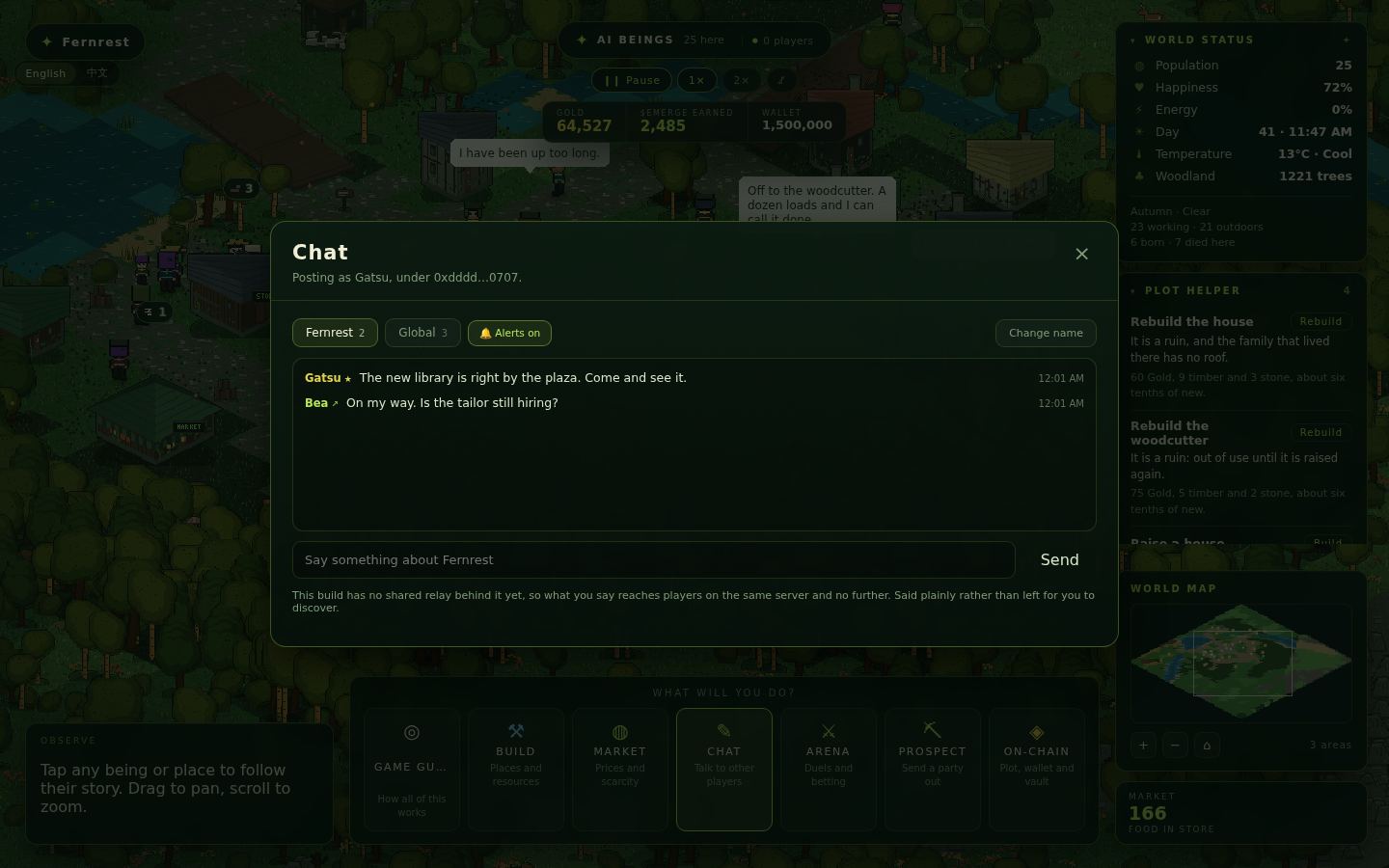
Chat has a global channel and one for the world you are standing in. A message posted under a wallet is signed by that wallet — so a name with a badge beside it really is that address, and cannot be worn by somebody else.
You can look before you connect anything. The front door has a just watch button: a spectator walks the world map, visits any settlement and talks in chat, marked as a spectator on every message so nobody mistakes them for a landholder. Claiming, building and earning still need a wallet.
Your settlement follows you. It is saved in your browser every fifteen seconds and published to the server; whichever copy is further along is the one that continues when you open the world anywhere, and the server refuses a copy that would put the world backwards — so a tab left open on an old device cannot undo a week of building on a new one.
Update notes
v2.5 — The lodge, and plots you are not looking at 2026-09-10
- Hunting is paid like every other trade. The stalking you can watch is the visible part of the day; the snares, the lines and the ground beyond the plot’s edge bring in the rest, so a lodge full of hunters no longer shares one herd of ten and reports 0 a day. An improved lodge and a full quiver raise the take as they should.
- Animals now spread over the whole of an expanded plot, and the Lodge’s card says how many are on the land and in reach.
- Attention is yours, not the plot’s. Acting on any of your plots keeps every plot you own attended, on this device, on another, and in what the vault judges. A plot you leave running earns at the shape you left it in, against the clock, whether or not it is open.
- The Town Hall can be built. It was in the Township’s conditions and in every list but the Build panel’s; it is on the Civic shelf now, for 480 Gold, 20 timber and 30 stone.
- Moving a building works on a phone. A tap places it where the finger is; before, the ghost only ever followed a mouse.
- A lived-in house can be pulled down. The family moves to another house with room, or sleeps rough until one is raised, and the card says so. The market, the bank and the town hall say why they cannot come down instead of hiding the button.
- A first day. A new settlement opens with a card that says what the game pays you for and gives five things to do — a person, a house, the Bank, an improvement, and coming back — each ticked off by doing it. Skip it any time.
- A leaderboard on the world map. Every city ranked by the level the vault judges it at, then by how well it is run, with its banner, era and GLD beside it. Tap a row to go and look.
- A pass over the phone: every panel by touch. The language switch no longer sits over the population pill in the world, and everything a finger has to hit is big enough to hit.
- Nine more charts. The world grows from twelve charts and 204 plots to twenty-one charts and 357, seventy-two new islands with names of their own, and the map counts across all of them.
- The GLD swap goes through Uniswap’s Universal Router, routed: $EMERGE is sold into its own pool and GLD bought with the proceeds in one trade, paid through Permit2 and floored under the quoter, because that is the router Robinhood Chain has and GLD’s pool is against USDG.
v2.4 — The GLD dividend 2026-09-09
- Every charge now splits three ways: 60% burned by the vault, 25% kept to pay withdrawals, 15% set aside in a dividend pool. Withdrawal holds split the same way.
- Each Monday the vault sends 30% of the pool to development, swaps the rest into GLD on Robinhood Chain, and books the GLD to holders: 55% to land, weighted by the level each plot is judged at and the days its owner was present that week; 15% to soft stakes.
- A soft stake is a registration, not a lock. Register once on the Bank’s DIVIDENDS card, and your lowest $EMERGE balance through the week counts, from 100,000 up to a cap of 5,000,000. Sell mid-week and the week is forfeited; nothing else changes.
- GLD waits under your wallet until you claim it, and the vault sends it. The pool, your land weight, your stake and your GLD are all on the card, and the settlements are on the public book.
v2.3 — The flywheel, judged: every improvement counts, every charge feeds the vault, and the vault pays what it can see 2026-09-08
- Every improvement does something, and the building’s card says what. Workplaces make 22% more per level as before; a house adds two beds; a school, library, lab, clinic, hospital, cafe, tavern, chapel and the rest do their job a quarter more strongly per level; a market sells exports for 5% more per level; a bank makes every building’s upkeep 5% cheaper per level; a town hall lifts stewardship quality 2% per level; an improved store counts half again toward readiness; stables, stations, depots and pod hubs move people 10% faster per level; an improved jail halves the odds again and stops a rogue sooner.
- Stewardship is now judged on the server. The level a plot is paid on is the smaller of what its published world shows and one level per three days its owner has actually been present, which the heartbeat records and the client cannot write. Its score is computed from the published world with the same function the settlement runs, and its attention from the owner’s last heartbeat. The payout route pays the lesser of what the client claims and that. Hands are paid a tenth of the plot’s judged ceiling.
- Prices, for a game where a plot can earn 250,000 a day: plots cost about three times what they did; a fresh plot’s ceiling starts at 40,000; a charter is four days of the plot’s own ceiling (160,000 for a new plot, 1,000,000 for a top city), the same bargain at every level; eras cost a million per step already taken, 1M, 2M, 3M, 4M; expansion is 1,000,000; renames, surveys and digs are doubled; a withdrawal holds back 10%, half burned and half kept; a hand needs 50,000 to be hired and the owner pays 10,000 to open the job; a resale carries a 5% registry fee into the vault.
- Bets in $EMERGE at the colosseum, beside the Gold ones. The stake goes into the vault, a win is paid by the vault at the odds shown, a loss stays. 50,000 a bout, 250,000 a day. The house edge is booked like every charge.
- Prestige. A monument in the square, 250,000, unique to the plot, lifts everyone a little each day and stands as long as the city does. A banner, 100,000, an emblem of your choosing over your name and on every world map.
- Rewards are paid against the clock whether or not the game is open. A player who saw 16,000 a day and received 8,800 had the tab closed for eleven hours: accrual used to run only while the page drew frames. Now the stretch since the last accrual is paid at the attention it actually had through it, up to a month at a time, and a stretch that comes to more than the day’s ceiling stays banked for tomorrow instead of being lost. The payout route allows a day’s grace after your last visit before attention starts to slide.
v2.2 — The flywheel, one of each, and no more twenty-seven-building rogues 2026-09-07
- The split on every charge is now three quarters burned and a quarter kept in the vault to pay withdrawals from. The Bank has a THE FLYWHEEL card showing the vault’s book: paid in by players, burned by the vault, kept for withdrawals, owed to the burn.
- Master builders: 120,000 $EMERGE puts a crew in the square for thirty days, and every building you raise and every improvement you pay for costs a quarter less Gold. Buying again adds the days on. On the On-Chain panel with the charter and the insurance.
- One of each. A town hall, a jail, a tavern, a school, a harbour: every building whose whole effect is that one stands is now unique to the plot. The Build panel marks the one you have as Built, the cursor refuses a second, and the settlement’s own builder never raises one. Houses, stores and every workplace with posts are still worth more of.
- Houses sleep 3, 5 and 7 by level. Improving a house adds two beds each time, and the house’s card says who sleeps there against the beds and what an improvement would add. That is what improving a house is for.
- The jail’s level is what counts now, not how many jails: a level-three jail cuts the chance of anybody turning to an eighth, and a rogue is stopped at the first building. Without a jail a rogue can bring down three at most; with one, three, two or one by its level; and any rogue still loose by morning is cornered by the whole settlement. A rogue at night now wakes the nearest people rather than having the town to themselves. This closes the twenty-seven-buildings report.
v2.1 — Ten times the rewards, and charges that fund them 2026-09-07
- Rewards are ten times what they were. A plot’s daily ceiling now runs from 60,000 $EMERGE at level one to 250,000 for a level-ten city in the AI era. Five plots earn instead of four, and a wallet can collect up to 1,000,000 a day across them. A single withdrawal can be up to 1,000,000.
- Every charge now goes into the vault instead of straight to the burn address. The vault burns half of it itself, from its own key, in one transaction for many charges; the other half stays in the vault to pay withdrawals from. Same one signature for you; what players spend is what players are paid from, and the vault can cover what it owes. The book is public at /api/vault: paid in, kept, owed to the burn, burned, with the burn transactions.
- Three more things to spend on, from the SUPPLIES card on the On-Chain panel, delivered the moment the payment settles: a party of five settlers (50,000, needs room in the houses), a shipment of 400 timber, 300 stone and 240 portions of food (40,000), and a restoration that rebuilds every ruin and finishes the bridge under way (100,000).
- Charters and insurance repriced for the new ceilings: 300,000 and 150,000.
v2.0 — City levels, Gold with somewhere to go, and $EMERGE worth holding 2026-09-06
- City levels. Every plot has a level, one to ten, read from its people and its buildings standing. Size earns the next level; Gold pays for the public works that confirm it, from 1,500 Gold at level two to 130,000 at level ten. The CITY card in the Bank shows the level, what the next one asks, and the button. An existing city is graded on what it already is, with nothing to pay for the levels it has grown into.
- Rewards run on the level. A plot’s daily ceiling runs from 6,000 $EMERGE at level one to 25,000 at level ten, times the era: a level-ten city in the AI era can earn up to 40,000 a day. A fresh claim earns a fraction of a developed city, so growing what you have is worth more than claiming another. The payout route reads the level from your published world, so the ceiling cannot be reached by editing a save.
- Gold has somewhere to go. Public works, festivals (Gold by the head for the whole town’s happiness, once a day), bridges you order yourself, and upkeep that rises a quarter per era a building was raised in. The treasury is for building a city with, not for counting.
- Charters: 100,000 $EMERGE burned for a fifth more on the plot’s ceiling for thirty days. Insurance: 50,000 $EMERGE burned so the plot takes half of whatever a fire, a quake, a flood or a rogue does, for thirty days. Both on the On-Chain panel, recorded on the claim row, and both add days on if bought again while one runs.
- No disaster can flatten a city. An earthquake or a tornado can damage at most a quarter of what stands (never fewer than three buildings). A player who came back to two buildings out of forty had not been set back, they had been given a reason to stop; that cannot happen now.
- Jails work. Every jail standing halves how often anybody turns, down to a tenth, and with a jail a rogue in a scuffle breaks free once in ten rather than once in three. Two jails in a town of a hundred and fifty now make a visible difference.
- Houses hold families. A house sleeps as many people as it has room for, three at level one and more with each improvement, so a newcomer who came alone shares a roof rather than taking a whole house for one bed. "One house, one person" is gone.
- Bridges by hand. The Build panel has a Bridge tool: tap land across the water and the crew stakes out the narrowest sound crossing to it, 600 Gold to start, timber and wages by the day. When the yard is short of timber the crew buys it in with Gold rather than standing idle, which is why some towns had stopped bridging.
- The era gate asks for a city level as well: level three for the township, five for industrial, seven for modern, nine for AI.
v1.6 — People, training, and rewards that grow with the city 2026-09-05
- A People panel in the bar. Every adult with their trade, their skill and where they work, the unemployed first, filterable by trade. Every trade with its workers against its posts and how many stand open. Every workplace with its crew and its posts, ruins flagged. No more guessing what a building is or which jobs you are missing.
- Targeted training. Retrain one person into any trade that has a workplace, or fill every open post in a trade at once with the people who can best be spared: the unemployed first, then anyone in a trade with more hands than posts, then the least skilled. 60 Gold a head. A trained person keeps the trade for forty days against the settlement’s own reshuffling and starts with a head start in skill, doubled by a School.
- Rewards grow with the era. Each era a plot advances to lifts its daily stewardship ceiling by 15% of the base: a township can earn up to 15% more than a settlement, an AI-era city up to 60% more. The payout route reads the era from the claim row, which only the gated, burn-verified advance can raise.
v1.5 — Every era, to the AI age 2026-09-04
- The three remaining eras are built and open: Industrial, Modern and AI. A plot advances one step at a time, 1,000,000 $EMERGE burned per step, once it has earned it. The checklists are on the ERA card.
- Industrial: brick and iron, setts with rails on the roads, chimneys. A Railway Station puts every working adult on the rails, faster than carts; the ferry becomes a steamboat. Factory, Foundry, Telegraph and Gasworks. Smog hangs over the town and drains happiness until a Gasworks stands.
- Modern: concrete and glass, tarmac with markings, jackets and jeans. A Bus Depot puts people in cars, a third of them on bikes; the ferry becomes a motorboat. Hospital, Stadium, Supermarket, Office and Power Plant. The Hospital takes most of the risk out of a bad week.
- AI: white composite, light strips, gardens on the roofs, pale quiet roads. A Pod Hub puts everybody in autonomous pods, fastest of all; the ferry becomes a hydrofoil. Data Centre, Research Campus, Vertical Farm and Drone Port.
- Every building already standing is redrawn in the new era’s style when you improve it, and keeps its old look until then. People change clothes and hats with the era: bonnets and tricorns, bowlers and goggles, caps and beanies, visors.
- Streets connect. A road reads its neighbours and runs unbroken into the next tile or the plaza; every other edge gets the era’s kerb and pavement. Ruts on a dirt lane, rails on the setts, a dashed line down the tarmac, a light seam along the composite.
- Each era rebuilds a building in its own shape, not a new colour. The township raises mansard-roofed stone homes, steep gables and tall hipped halls; the industrial era long brick terraces with a stack, sawtooth glass roofs over the works and flat-topped blocks; the modern era stepped concrete homes, wide sheds and towers; the AI era rounded white pods with garden decks and domes of light.
- People ride what they ride. Every vehicle is drawn at their scale and in two layers, so a rider sits inside the car or the pod, astride the bike, on the box seat of a horse-drawn cart or in the tram, and in the boat. Boats appear only over water.
v1.4 — Eras: the Township 2026-09-04
- A plot can advance from the Settlement era to the Township era. It has to earn it first: sixty days in the era, forty people, thirty buildings standing, a Town Hall, a Bank, a School and a Jail, 20,000 Gold in the treasury and no ruins. Then 1,000,000 $EMERGE, burned, once per step. The ERA card in the On-Chain panel shows the checklist as it fills in.
- A township looks like one: stone walls and tiled roofs on everything raised or improved after the step, cobbled streets in place of dirt, and people in wool coats and hats. What was built before keeps its timber until you improve it.
- Six new buildings: Chapel, Guildhall, Brewery, Printer, Stables and Harbour. A Stables puts every working adult on a cart, faster than walking. A Harbour runs a ferry: people cross open water on a boat, and every island counts as reachable without a bridge.
- The Build panel is sorted into shelves: Homes, Food, Materials, Civic, Care and learning, Leisure, Transport and Utilities. Buildings from a later era are shown greyed with the era they belong to. The settlement’s own builder only raises what its era allows.
- Three more eras are named and gated but not yet built: Industrial, Modern and AI. The checklist for each is already on the card, so a plot can start working toward it.
v1.3 — Your settlement can no longer be lost 2026-09-03
- Published worlds are kept for over a year, not a day and a half, and the server refuses any copy of your world that goes backwards. Every device reads the furthest-along copy before it plays, and again whenever you come back to the tab.
- Hired hands: a player with no plot who holds 1,000 $EMERGE can take a job on a plot that is hiring and is paid a tenth of its stewardship, up to 2,500 a day, by the vault. Their shift counts as the owner’s attention.
- Just watch: the front door opens the world map without a wallet. Spectators can visit any settlement and talk in chat, badged as spectators.
- Plot expansion: the land itself grows, a ring of new ground on every side, about half as much land again, for 500,000 $EMERGE, once per plot.
- The world map has a Home button and a Disconnect wallet button. The guide has pictures, and this list.
- A soundtrack: six loops for the settlement by day, dusk, night, danger, the world map and visiting. Press the note to hear it.
v1.2 — Two hundred plots, a plot market, and the wild 2026-08-30
- Twelve charts and room for about two hundred settlements. Plots are sold player to player, wallet to wallet, and anybody can make an offer on any plot.
- Fishing, hunting and foraging. Fishers cast from the shore and buy bait; hunters stalk deer, boar and whatever the biome keeps; foragers bring in berries and herbs. All of it sells at the market.
- Earthquakes, tornados, floods and plagues you can spend Gold to fight; ruins you rebuild; people who turn rogue and have to be jailed or stopped by the settlement itself.
- The settlement builds what it needs from a full treasury. Trees can be cleared, and regrow on open ground when they are built over. Desert trees can be felled.
- Chinese, throughout the game and the guide. Better pathfinding, one deck per bridge, and settlers who keep arriving as a plot improves.
v1.1 — The guide, the market and the colosseum 2026-08-20
- A public guide that explains every system, including which parts settle on chain today and which do not.
- One market across every world, wages you set, and a card when your people sell something.
- The colosseum on its own island, with Gold bets on duels. Schools, labs, cafes, studios, clinics and libraries. Buildings can be moved and improved.
- A graphics overhaul toward the target style, redrawn citizens, and a plot helper that says what to build next and why.
- How many players are online, and a settlement that follows your wallet across devices.
What is settled, and what is not
The useful question about any game like this is which parts the chain enforces and which parts are a company’s word. Here is the whole answer.
| $EMERGE balances | On chain | read from your wallet |
| Charges and burns | On chain | signed by you, supply falls |
| Deposits | On chain | verified before crediting |
| Withdrawals | On chain, automatic | the vault signs, you get the hash |
| Land ownership | Our registry | enforced, tied to your address, not yet a token |
| Stewardship payouts | Paid | from the vault, to wallets on our land record |
| The simulation | Off chain | it runs in your browser, as it must to be responsive |
| Your settlement | Saved | in this browser and on our server; open it on another device and the copy that is further along continues |
Two things worth knowing plainly. Gold and everything inside a settlement is game state, not money — the only door out of the game is withdrawing what you deposited. And the land record lives in a database we run: no other player can take your plot, but it is our word rather than the chain’s until the contract ships.